At the same time, reading broadly over Part 3 on Checkmate and Part 4 on Castling before reading this post may help the beginner get a better overall understanding of how to play chess. This post on chess notation is Part 2 of the beginner's guide, though, because it will be impossible to fully read Part 3 and Part 4 without understanding chess notation.
The major obstacle in learning chess notation is a language problem. Chess is written in a very simple language called algebraic notation. This simplicity is a great help to skilled players who understand the language. It is easy for them to look over the notations and figure out the moves very quickly. However, this simplicity can leave beginner's feeling very lost. The language of chess is not very explanatory.
On top of this, learning any language is difficult. It takes time and practice. Beginner's should understand and expect to feel lost in the early stages. If you found yourself in China (assuming you dont understand Chinese), you would feel very lost. You wouldnt expect yourself to be able to do all of the fun things you can do when you understand the native language.
Learning to read the notation takes time, and will likely give you a head ache. But, it is critical to improve your chess. Also, it allows you to better appreciate the chess games of the highest level players, both past and present. Thus, people who arent interested improving their chess can still benefit from learning chess notation.
Similar to learning the how the chess pieces move, the best way to learn chess notation is too practice. Before I get to how I recommend practicing, though, we should go through the basic ideas behind chess notation.
First, columns are lettered a through h, and rows are numbered 1 through 8. To notate a square, you would identify the column by "e", for example, and the row by "4", for example. Thus, by writing "e4", you notate the e4 square on the chess board.
Dont worry about understanding all of that just yet. Later on, I will show you a good way to practice learning chess notation. We are just trying to get a basic handle on the ideas of chess notation here.
The second thing you need to know is how to identify which piece moves to the square. Pieces are identified by a capital letter, which is placed in front of the "e4" that identifies the square.
The following shows the capital letters used in English chess notation:
King: K
Queen: Q
Rook: R
Bishop: B
Knight: N
Pawn: Nothing. If none of the above letters are used, then it is a pawn move. For exampled, e4, d5, e3, b5 are all notations for pawn moves.
Similar to how the pieces move, chess notation of the pieces is pretty straight forward except for the Knight and Pawn. Just use the first letter of the name of the piece! For the Knight, this is not possible because the King is identified with a K. Thus, you use the second letter of the word Knight, "N".
For pawns, for some reason, no letter is used. Every now and then you will see pawn moves notated with a "P". This is fairly rare, though.
As an example, then, if you want to show that a Knight moved to the e4 square, you would write "Ne4". If you want to show a pawn moving to e4, you write "e4". If you want to show a Bishop moving to e4, you write "Be4".
These are the basics of chess notation. However, there are a few other things you need to know.
First, when there is a capture, it is notated with an "x".
For example, if I take your Knight on f6 with my Knight, the notation will be Nxf6. Sometimes, the "x" is omitted. Thus, if I take your Knight of f6 with my Knight, it will be notated as Nf6. It is just assumed that my Knight took your Knight. This can be a bit confusing though, so usually a capture is notated with an "x".
Second, when there is a check, it is marked with a +. A checkmate is marked with an #. Thus, if I move my Bishop to attack your King, it will be notated Bb5+. If I move my Queen to checkmate your King, it will be notated Qe7#. To learn more about Checks and Checkmates, read A Beginner's Guide, Part 3, Winning.
Third, a King side castle is notated 0-0. A Queen side castle is notated 0-0-0. To learn more about Castling, read A Beginner's Guide, Part 4, Castling.
Now you know all the symbols used in chess notation. However, there is one more thing you need to know. Sometimes, two of the same type of pieces can move to the same square. It is necessary to clarify which piece actually moved to the square. If two pieces can move to a square, an extra letter or number is given to indicate which piece actually moved.
For instance, say you have a Knight on f6, and a Knight on b8.
Both of Black's Knights can move to the d7 square. So, if you play the b8 Knight to the d7 square, and only notate it Nd7, you wont know which Knight was the one that moved to the d7 square.
Instead, it is notated as Nbd7. The "b" indicates that it is the "b" Knight that moves to the d7 square, not the f6 Knight.
Sometimes, it is not possible to clarify which piece moves by letter, though. Say, for instance, you have a Knight on the d7 square and a Knight on the d5 square.
Both of Black's Knights can move to f6. If you write Ndf6, it will not clarify which Knight moved to f6. Thus, a number is used instead. If you move the d5 Knight to the f6 square, it will be notated N5f6. The "5" indicates that the Knight on the 5th rank is the one that moves.
Now you know everything you need to know to read and write chess! However, unless you are a very fast learner, you probably arent very fluent in chess notation yet.
Here is a good way to practice learning chess notation.
The first thing to do is go to a chess game website that uses algebraic notation and has the sides of the board labeled. My favorite site of this nature is chessgames.com. Clicking on the link will take you to the Chessgames.com's Game of the Day for June 13, 2010.
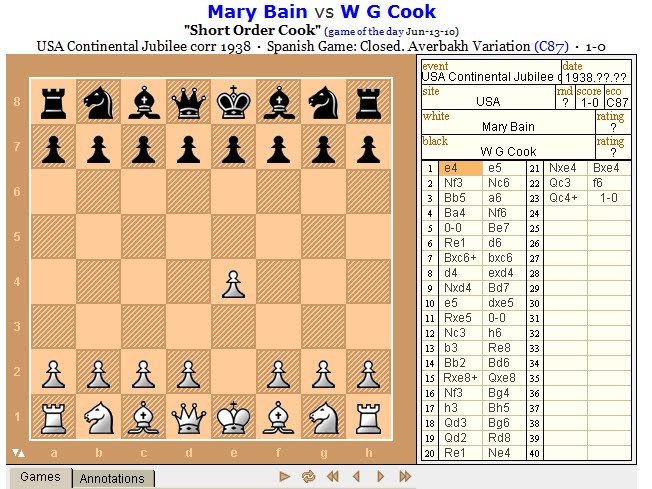
You should see the following: (Sorry the image is a little blurry, I am still figuring out some technical things)

As can be seen here, on the bottom of the chess board are the letters a through h indicating each of the 8 columns. On the left side of the chess board are the numbers 1 through 8 indicating the rows. Unfortunately, no numbers or letters are on the top or right side of the chess board. This isnt too big a deal though, but it may be helpful for you as a beginner to have the numbers and letter go the whole way around the chess board.
To the right of the chess board is a table with numbers in a smaller column 1 through 23. These numbers represent the move number. Beside this column of numbers are two larger columns. The first column next to "1" has has the notation "e4". This is White's first move. Because there is no letter in front of the e4, we know this represents a pawn move.
Looking at the numbers on the right side of the board, find the number "4". Then, looking at the letter at the bottom, find the letter "e". Go up the "e" column until you reach the "4" row. You have just found the square the pawn is going to move to. Only one of White's pawns can move to this square legally, and that is the pawn on e2. Therefore, you have just figured out that the pawn on e2 moves to the e4 square on White's first move.
If you are an absolute beginner, you may be a bit lost at this point. That is why we are using chessgames.com though, instead of doing it over the board.
Notice the arrows and buttons below the chessboard. From left to right, these are "Games", "Annotations", a large arrow that is "Play", a pair of curvy arrows that I believe flips the board (mine doesnt work), a double arrow pointing left that takes you to the beginning of the game, a single arrow pointing left that goes back one move, a single arrow pointing right goes forward a move, and a double arrow pointing right that takes you to the end of the game.
Right now, ignore all of these things but the single arrow pointing right. Click this arrow, and you should see the following:
That "1. e4" now appears on the board! Hopefully, this is the move you thought was indicated by 1. e4 meant. If it wasnt, that is ok. You will get the hang of chess notation eventually.
Hit the arrow again. You will see that Black's e pawn moved forward to e5. Looking at the list of moves, you will see that in the second column besides the "1", there is the notation "e5". This is Black's first move.
You can continue hitting the arrow button, and White's moves from the first column and Black's moves from the second column will be played.
When you get to White's 5th move, you will see "0-0" in the list of moves. Remember from above that this represents King side castling. "0-0-0" represents Queen side castling. Once again, for information about castling see my post A Beginner's Guide, Part 3, Castling.
Eventually you will get to White's 7th move, "Bxc6+". Remember the "x" represents a capture, and White has just captured Black's Knight. The "+" represents a Check, and Black's King is currently under attack by White's Bishop.
Interestingly, this game does not feature any moves where more than one of the same type of piece can use a square. So there isnt any "Nbd7" or "R2e4".
Finally, notice how the "#" symbol isnt used in this game. This is because the Black player, W G Cook resigned before getting checkmated. Cook resigned in the final position because he was about to lose his Light Squared Bishop on e4, and didnt want to play on a piece down. It is common in chess games for players to resign before they get checkmated.
Going through games on a chessgames.com or a similar site that shows the board, the 1 through 8 and a through h markings on the side of the board, and the moves on the side in algebraic notation is a good way to learn chess notation. Try and find the moves that are notated before clicking the next move arrow. Then, click the next move arrow and see if you are right. After a while, reading the chess notation will become second nature.
Another benefit from learning chess notation in this way, is that by going over these high level games you will begin developing your chess intuition. You will not understand a lot of what happens on the board, but your brain will start to put together various pattern. This is a critical part of improving your chess, and you will be getting a head start!


