Having read A Beginner's Guide, Part 1, How do the pieces move?, A Beginner's Guide, Part 2, Chess Notation, A Beginner's Guide, Part 3, Winning, and A Beginner's Guide, Part 4, Castling, you now know the basics of how to play chess.
However, you likely often wonder why or what you should move. You are able to see that you can move your knight, you can move your bishop, and you can move your Queen, but you have no idea which one of these pieces to move. Even worse, you dont even know how to analyze which of these pieces to move. You have no real goals other than the vague notion of checkmating your opponent's King. Even worse than that, you probably dont have any idea how to come up with real, specific goals. Basically, you have no idea what you are doing. This is when chess gets difficult, and this is generally the stage where beginners give up on chess.
You may have noticed through your study of the basics how complicated chess is. It is really really complicated. As an anecdote, Chess Endgame Tablebases exist for up to 6 pieces. These databases use very simple text notation, yet the files are 1000s of Gigabytes! If you write a 1 page paper on Notepad, the file will be about 1 or 2 kilabytes. To write a 1000 Gigabyte paper (also called 1 Terabyte), you would have to write a 1 billion page paper! This is just for the simple stuff in chess, like Queen, Pawn and King v Queen, Pawn and King. A common phrase in chess (and backed somewhat by math) is that there are as many possible moves in a 40 move chess game as there are atoms in the universe.
So, chess is complicated. This is why it is so difficult to come up with real, specific goals. For every attacking idea you may have, your opponent has 10 to 20 responses. After that, you have 10 to 20 responses. How can you think past 1 move when there are literally 1000s of possibilities? How can you study your game when you are likely never going to see these same moves again? How do we deal with all of this?
Well, lets simplify it. By breaking chess down into categories, we can decrease some of the complexity. By decreasing the complexity of a chess game, we can give ourselves some specific goals. Then, when we have 100s of possibilities to look at, we can find a move that achieves one of our goals and play it. With this framework in mind, you, as a beginner, will not feel so lost and aimless when playing chess.
So, lets simplify a chess game into three stages:
1) Opening
2) Middlegame
3) Endgame
Lets define each of the above.
The Opening of a chess game is the first 10 to 20 moves.
The Middlegame of a chess game is the most complicated portion of the game.
The Endgame of a chess game is the part of a chess game where each side has one to three pieces, not including the King or pawns.
That is pretty easy, right? We havent actually come up with any goals in the chess game, but at least you know what to study next. You need to study Chess Openings, Chess Middlegames and Chess Endgames. [POSTS ALL COMING SOON, You can google these topics in the meantime if you wish.]
To end this post, I am going to provide an analogy that should bring a bit of relief to any chess beginner. You have probably done all of the above (or if you are too young, you will). I am referring to driving a car. After all, the possibilities of driving a car are endless and similar to chess.
At first, you only have some vague goal of getting from Point A to Point B, just like you have a vague goal of checkmating your opponent's King. To get to Point B, though, you just simplify everything, by following a series of simple directions: left on Wilson St, Right on Oak Lane, Right on Main St, and enter the Parking Lot of Big Store.
While you are driving down Wilson St., you dont think too much about all the cars around you. You dont think to yourself, "Ok, there is a Green Ford one car ahead of me, a Blue Honda two cars ahead of me, and a Cheverlot Pick Up Truck three cars ahead of me. A Red Toyota just passed me on the other side, a Blue Toyota just passed me, a Green Ford just passed me. I need to push the gas down to move forward, I need to let off the gas a bit to slow down. etc. etc."
If you did, you would go crazy.
Instead, you have some basic rules of thumb that you follow.
I drive on the right side of the road. I will keep about one or two car lengths between my car and the car in front of me. I will keep my eye on the sides of the road so I can stop quickly if anything jumps in front of my car.
By simplifying the process into various groups, you can ignore a lot of the details that would otherwise make driving impossible. For instance, there is your car, and then there are other cars. Aside from police cars, ambulances and other types of vehicles, it doesnt really matter what type of cars the other cars are. They are just other cars.
As far as Streets go, they also are pretty much the same. It doesnt matter whether you are on Wilson St or Oak Lane, just drive on the right side of the road and stop at the stop signs.
You dont need to think about how far down you push the gas pedal. If you are going to fast, let off the gas and if you are going to slow push down on the gas pedal.
As you will see, you can use this same process to make chess a lot easier. One major difference with the driving analogy, though, is that while you are driving no one is trying to hit you. In chess, everyone is trying to hit you!
Still, though, if you drive you already do the type of thinking that is critical to be successful at chess. It is simply a matter then of transferring that same type of thinking to a new thing. Easy!
Showing posts with label Study. Show all posts
Showing posts with label Study. Show all posts
Saturday, July 17, 2010


Wednesday, June 16, 2010
A Beginner's Guide, Part 4, Castling
Castling is a new move in chess. Well, relatively new. It became popular in its current form around the 1700s to 1800s. The basic idea was to speed up the game. Because the King is a slow moving piece, players in the past would have to spend 3 or 4 moves setting up the castled position. Instead of doing all of this, now a days, players can castle in one move. Players can castle either towards the right side of the board, called the Kingside, or to the left side of the board, called the Queenside.
As a brief aside:
From the d file to the left is called the Queen side. From the e file to the right is called the King side. These names arent official and have no real impact on the game. It is simply a way for chess players to talk or write about various chess concepts in a simple way. For example, "I was attacking on the Queen side and he was counter attacking on the King side," or "I had a Queen side pawn majority and he had a King side pawn majority."
Back to castling.
Before a player can castle they must make sure there are no pieces in the way.
In this position, note that the squares f1 and g1 are clear. White's Knight and Bishop have moved off of these squares, and now White can castle King side.
When you castle Kingside, you place your King on g1. Then you place your Rook on f1.
There you have it, quick learning beginner. You now know how to castle King side!
Queen side castling is also possible. It is very similar to King side castling.
Notice how in this position the squares b1, c1, and d1 are all clear. With nothing blocking the way, White can castle Queen side. To castle Queen side, White places his King on c1, and his Rook on d1.
Simple!
Well, unfortunately, not quite that simple. There are a few other rules of castling.
The first rule is that neither the King nor the Rook the player wants to castle with can move. If either piece moves, castling is not possible.
Looking at the above example of Queen side castling, if White move his Rook to b1, and then back to a1, he will not be allowed to castle Queen side. However, if he moves his Light Squared Bishop off of the f1 square, he will still be able to castle King side.
If he moves his King to d1, though, he will not be allowed to castle either King side or Queen side.
Finally, the King is not allowed to move through check to castle. Check, and checkmate were explained in A Beginner's Guide, Part 3, Winning. Keep in mind that the Rook is allowed to move through an attack, though.
As a beginner, dont worry too much about moving through Check. Just know that if the computer is not allowing you to castle, this may be why.
Monday, June 14, 2010
A Beginner's Guide, Part 3, Winning
The goal of chess can be a bit confusing for a beginner.
Basically, the goal of chess is to capture the opponent's King. Sort of.
In the old days, meaning 500-700, this was the goal of chess, or rather, of the early forms of chess. Around 700-800, however, new rules were introduced to make the game more interesting. Hence, Check and Checkmate were developed.
The idea of Check is that if an opponent's King is in danger of being captured, you say Check, informing your opponent of this danger. He then knows that he should move his King, otherwise you will capture it and the game will end. This is basically a courtesy you give to your opponent so that a good and interesting game is not ended prematurely by a foolish blunder.
Eventually, this courtesy was changed into a rule of the game. Now a days, it is illegal for your opponent not to parry the threat against his King. If your opponent does not parry the threat, you do not capture his King and win the game. Instead, you inform your opponent of his illegal move, go back, and he has to make a legal move.
Looking at my Chess Tactic of the Day #3, find the move Ng6+. When the Knight moves to g6, it is attacking the King. Thus, the King is in check and must somehow parry the threat of the Knight. In this position, the only way to parry this threat is to move the King, so the Black King must move.
The Black King cannot move into Check, and so his only legal moves are f5 and g5. He cannot move to e3, e4, or e5 because the Queen is threatening those squares. Similarly, he cannot move to g3 because the Queen is threatening this square. The Bishop is threatening the f3 and g4 squares, so the King cannot move there.
This is how Check works. The King is threatened by another piece, and your opponent must protect his King. He can move his King to an unthreatened square, he can capture the piece that is threatening him, or he can block the threat with another one of his pieces. Dont get hung up on these three things just yet.
Following from this, then, is the idea of checkmate. This is occurs when your opponent's King is in check, ie, in danger of being captured, but he is unable to parry the threat against his King.
This position occurs if Black decides to parry the threat against his King by moving to the f5 square. In this position, it is White's move and he can checkmate Black's King. White checkmates Black's King by playing Qe5#.
First, notice how the Black King cannot capture the White Queen. The Queen is protected by the Knight. Thus, Black cannot parry the threat against his King by capturing the attacker. Second, notice that White's King is defending the White Knight, so Black cannot capture the Knight.
Black must move to get away from the Queen's threat. The problem for him is that he cannot move to a safe square. Black cannot move his King to e6 or e4, as the Queen is threatening those squares. Similarly, the Queen is threatening g5 square. Both White's Queen and Knight are threatening the f4 square. Both White's King and White's Queen are threatening the f6 square. Finally, White's Bishop is threatening the g4 square.
White has threatened all of the squares the Black King can move to, and Black cannot capture the Queen that is threatening his King. Finally, Black has no way of blocking the Queen's attack against his King. Black's King is in check, and he has no way to parry the threat. Thus, Black is checkmated.
Lets go back a second and see what happens if Black had moved his King to g5, instead of f5.
In this position, White can still checkmate the Black king. White can do this by playing Qa5#. White can also checkmate the Black King by playing Qe5#, but lets look at Qa5# this time instead.
Here, again, we can see that the Black king is under attack by the White Queen. The Queen is too far away for Black to even consider capturing. Black has no pieces left that he could otherwise move between the Queen and his King. So, he cannot block the Queen's attack against his King. Thus, once again, Black's only choice is to try and move his King.
However, he has no safe squares to move to. The Knight is still protected by the White King. The White King is also threatening the f6 and h6 squares, so Black's King cannot move there. The White bishop is threatening the g4 square. White's Queen is threatening f5 and h5. Finally, White's Knight is threatening the f4 and h4 squares.
Notice in this checkmate position how each of the pieces has a job, and how well the pieces work together with each other. That is a bit more advanced concept, but spotting this type of harmony between the pieces is always helpful!
One last thing with this position, look how things both change and do not change if Black has an extra piece.
I have added a Black Rook to the position. Here, Black can parry the Queen's threat against his King by playing Rd5. This prevents checkmate, but unfortunately for Black, it only prevents it for one move. White can play Qxd5, and the position is effectively the same as it was with the Queen on a5. Black cannot parry the threat again, and so he is still checkmated.
This position doesnt look all that realistic, though, does it? Chances are, very few of your games will ever reach this position. However, solving these types of tactics can help you get a grasp on piece harmony.
Lets look at one more example though, and this time we will look at something a bit more realistic. This game was played by an interesting massive lego/robot chess board!
Hopefully, if your games look like this you are playing Black! I am going to ignore the opening and skip to move 7.
White's King is under attack by Black's Bishop on f2. The King cannot capture the Bishop, because it is defended by Black's Knight on e4. The King cannot move a piece between the Bishop and his King, because the Bishop is right next to the King. Thus, the King must move.
The King cannot move to the f1 or d1 squares, because his Queen and Bishop are already there. He cannot move to the d2 square, because the Black Knight is threatening that square. His only other remaining square is e2, and so the King must move to e2.
Now, Black's other Bishop is attacking the King. The King cannot capture the Light Squared Bishop on g4 because it is too far away. White is unable to move a piece to the f3 square. If he could, this would parry the threat and he would not be checkmated. White's only other option is to move his King.
His King cannot capture the Dark Squared Bishop on f2, because as noted before, Black's Knight on e4 is defending it. He cannot move to f1 or d1 because his Bishop and Queen are still there. Similarly, he cannot move to d3 because his Pawn is there. He cannot move back to e1 or to e3 because Black's Dark Squared Bishop on f2 is threatening those squares. He cannot move to d2, because Black's Knight on e4 is still threatening that square. Finally, he cannot move to f3, as Black's Light Squared Bishop on g4 is threatening this square.
If you are having difficulty following all this d2, f3, e4 chess notation, that is fine. Just look at the diagram, and try and find all the ways the Black pieces are preventing the White King from escaping checkmate. You can always name the squares later; for now it is good just to see how Black controls them!
Indeed, Black is controlling all the squares around White's King. White cannot move his King, and his King is in check. Therefore, White is checkmated, and Black has won the game.
As a beginner, all the different squares and possibilities for the opponent's King is probably overwhelming. For most beginner games, though, checkmate is achieved in less complicated ways. Here is an example of a simpler checkmate.
This is a fairly common and simple way to achieve checkmate. Black simply has his Rook and Queen take away all the squares along the 1st and 2nd ranks, and the White King has no where to go.
Here is another simple way for Black to checkmate White's King. Black's King defends the Black Queen. The Black Queen attacks the White King while the White King is on the edge of the board, and Black has achieved checkmate.
Checkmates can be achieved in all kinds of interesting ways. At first, you will probably try and achieve these last two simple checkmates. After a while, though, you may try and get more complicated checkmates like the one from Monster Chess.
Sunday, June 13, 2010
A Beginner's Guide, Part 2, Chess Notation
This second part of the beginner's guide will be focused on chess notation. Learning chess notation is critical to effectively and efficiently improve your chess. However, a complete beginner may want to spend some time getting used to how the pieces move by playing Chess Titans or another computer program before trying to understand chess notation. If you do not understand how the pieces move very well, learning chess notation will be much more difficult and less helpful.
At the same time, reading broadly over Part 3 on Checkmate and Part 4 on Castling before reading this post may help the beginner get a better overall understanding of how to play chess. This post on chess notation is Part 2 of the beginner's guide, though, because it will be impossible to fully read Part 3 and Part 4 without understanding chess notation.
The major obstacle in learning chess notation is a language problem. Chess is written in a very simple language called algebraic notation. This simplicity is a great help to skilled players who understand the language. It is easy for them to look over the notations and figure out the moves very quickly. However, this simplicity can leave beginner's feeling very lost. The language of chess is not very explanatory.
On top of this, learning any language is difficult. It takes time and practice. Beginner's should understand and expect to feel lost in the early stages. If you found yourself in China (assuming you dont understand Chinese), you would feel very lost. You wouldnt expect yourself to be able to do all of the fun things you can do when you understand the native language.
Learning to read the notation takes time, and will likely give you a head ache. But, it is critical to improve your chess. Also, it allows you to better appreciate the chess games of the highest level players, both past and present. Thus, people who arent interested improving their chess can still benefit from learning chess notation.
Similar to learning the how the chess pieces move, the best way to learn chess notation is too practice. Before I get to how I recommend practicing, though, we should go through the basic ideas behind chess notation.
First, columns are lettered a through h, and rows are numbered 1 through 8. To notate a square, you would identify the column by "e", for example, and the row by "4", for example. Thus, by writing "e4", you notate the e4 square on the chess board.
Dont worry about understanding all of that just yet. Later on, I will show you a good way to practice learning chess notation. We are just trying to get a basic handle on the ideas of chess notation here.
The second thing you need to know is how to identify which piece moves to the square. Pieces are identified by a capital letter, which is placed in front of the "e4" that identifies the square.
The following shows the capital letters used in English chess notation:
King: K
Queen: Q
Rook: R
Bishop: B
Knight: N
Pawn: Nothing. If none of the above letters are used, then it is a pawn move. For exampled, e4, d5, e3, b5 are all notations for pawn moves.
Similar to how the pieces move, chess notation of the pieces is pretty straight forward except for the Knight and Pawn. Just use the first letter of the name of the piece! For the Knight, this is not possible because the King is identified with a K. Thus, you use the second letter of the word Knight, "N".
For pawns, for some reason, no letter is used. Every now and then you will see pawn moves notated with a "P". This is fairly rare, though.
As an example, then, if you want to show that a Knight moved to the e4 square, you would write "Ne4". If you want to show a pawn moving to e4, you write "e4". If you want to show a Bishop moving to e4, you write "Be4".
These are the basics of chess notation. However, there are a few other things you need to know.
First, when there is a capture, it is notated with an "x".
For example, if I take your Knight on f6 with my Knight, the notation will be Nxf6. Sometimes, the "x" is omitted. Thus, if I take your Knight of f6 with my Knight, it will be notated as Nf6. It is just assumed that my Knight took your Knight. This can be a bit confusing though, so usually a capture is notated with an "x".
Second, when there is a check, it is marked with a +. A checkmate is marked with an #. Thus, if I move my Bishop to attack your King, it will be notated Bb5+. If I move my Queen to checkmate your King, it will be notated Qe7#. To learn more about Checks and Checkmates, read A Beginner's Guide, Part 3, Winning.
Third, a King side castle is notated 0-0. A Queen side castle is notated 0-0-0. To learn more about Castling, read A Beginner's Guide, Part 4, Castling.
Now you know all the symbols used in chess notation. However, there is one more thing you need to know. Sometimes, two of the same type of pieces can move to the same square. It is necessary to clarify which piece actually moved to the square. If two pieces can move to a square, an extra letter or number is given to indicate which piece actually moved.
For instance, say you have a Knight on f6, and a Knight on b8.
Both of Black's Knights can move to the d7 square. So, if you play the b8 Knight to the d7 square, and only notate it Nd7, you wont know which Knight was the one that moved to the d7 square.
Instead, it is notated as Nbd7. The "b" indicates that it is the "b" Knight that moves to the d7 square, not the f6 Knight.
Sometimes, it is not possible to clarify which piece moves by letter, though. Say, for instance, you have a Knight on the d7 square and a Knight on the d5 square.
Both of Black's Knights can move to f6. If you write Ndf6, it will not clarify which Knight moved to f6. Thus, a number is used instead. If you move the d5 Knight to the f6 square, it will be notated N5f6. The "5" indicates that the Knight on the 5th rank is the one that moves.
Now you know everything you need to know to read and write chess! However, unless you are a very fast learner, you probably arent very fluent in chess notation yet.
Here is a good way to practice learning chess notation.
The first thing to do is go to a chess game website that uses algebraic notation and has the sides of the board labeled. My favorite site of this nature is chessgames.com. Clicking on the link will take you to the Chessgames.com's Game of the Day for June 13, 2010.
You should see the following: (Sorry the image is a little blurry, I am still figuring out some technical things)

As can be seen here, on the bottom of the chess board are the letters a through h indicating each of the 8 columns. On the left side of the chess board are the numbers 1 through 8 indicating the rows. Unfortunately, no numbers or letters are on the top or right side of the chess board. This isnt too big a deal though, but it may be helpful for you as a beginner to have the numbers and letter go the whole way around the chess board.
To the right of the chess board is a table with numbers in a smaller column 1 through 23. These numbers represent the move number. Beside this column of numbers are two larger columns. The first column next to "1" has has the notation "e4". This is White's first move. Because there is no letter in front of the e4, we know this represents a pawn move.
Looking at the numbers on the right side of the board, find the number "4". Then, looking at the letter at the bottom, find the letter "e". Go up the "e" column until you reach the "4" row. You have just found the square the pawn is going to move to. Only one of White's pawns can move to this square legally, and that is the pawn on e2. Therefore, you have just figured out that the pawn on e2 moves to the e4 square on White's first move.
If you are an absolute beginner, you may be a bit lost at this point. That is why we are using chessgames.com though, instead of doing it over the board.
Notice the arrows and buttons below the chessboard. From left to right, these are "Games", "Annotations", a large arrow that is "Play", a pair of curvy arrows that I believe flips the board (mine doesnt work), a double arrow pointing left that takes you to the beginning of the game, a single arrow pointing left that goes back one move, a single arrow pointing right goes forward a move, and a double arrow pointing right that takes you to the end of the game.
Right now, ignore all of these things but the single arrow pointing right. Click this arrow, and you should see the following:

That "1. e4" now appears on the board! Hopefully, this is the move you thought was indicated by 1. e4 meant. If it wasnt, that is ok. You will get the hang of chess notation eventually.
Hit the arrow again. You will see that Black's e pawn moved forward to e5. Looking at the list of moves, you will see that in the second column besides the "1", there is the notation "e5". This is Black's first move.
You can continue hitting the arrow button, and White's moves from the first column and Black's moves from the second column will be played.
When you get to White's 5th move, you will see "0-0" in the list of moves. Remember from above that this represents King side castling. "0-0-0" represents Queen side castling. Once again, for information about castling see my post A Beginner's Guide, Part 3, Castling.
Eventually you will get to White's 7th move, "Bxc6+". Remember the "x" represents a capture, and White has just captured Black's Knight. The "+" represents a Check, and Black's King is currently under attack by White's Bishop.
Interestingly, this game does not feature any moves where more than one of the same type of piece can use a square. So there isnt any "Nbd7" or "R2e4".
Finally, notice how the "#" symbol isnt used in this game. This is because the Black player, W G Cook resigned before getting checkmated. Cook resigned in the final position because he was about to lose his Light Squared Bishop on e4, and didnt want to play on a piece down. It is common in chess games for players to resign before they get checkmated.
Going through games on a chessgames.com or a similar site that shows the board, the 1 through 8 and a through h markings on the side of the board, and the moves on the side in algebraic notation is a good way to learn chess notation. Try and find the moves that are notated before clicking the next move arrow. Then, click the next move arrow and see if you are right. After a while, reading the chess notation will become second nature.
Another benefit from learning chess notation in this way, is that by going over these high level games you will begin developing your chess intuition. You will not understand a lot of what happens on the board, but your brain will start to put together various pattern. This is a critical part of improving your chess, and you will be getting a head start!
At the same time, reading broadly over Part 3 on Checkmate and Part 4 on Castling before reading this post may help the beginner get a better overall understanding of how to play chess. This post on chess notation is Part 2 of the beginner's guide, though, because it will be impossible to fully read Part 3 and Part 4 without understanding chess notation.
The major obstacle in learning chess notation is a language problem. Chess is written in a very simple language called algebraic notation. This simplicity is a great help to skilled players who understand the language. It is easy for them to look over the notations and figure out the moves very quickly. However, this simplicity can leave beginner's feeling very lost. The language of chess is not very explanatory.
On top of this, learning any language is difficult. It takes time and practice. Beginner's should understand and expect to feel lost in the early stages. If you found yourself in China (assuming you dont understand Chinese), you would feel very lost. You wouldnt expect yourself to be able to do all of the fun things you can do when you understand the native language.
Learning to read the notation takes time, and will likely give you a head ache. But, it is critical to improve your chess. Also, it allows you to better appreciate the chess games of the highest level players, both past and present. Thus, people who arent interested improving their chess can still benefit from learning chess notation.
Similar to learning the how the chess pieces move, the best way to learn chess notation is too practice. Before I get to how I recommend practicing, though, we should go through the basic ideas behind chess notation.
First, columns are lettered a through h, and rows are numbered 1 through 8. To notate a square, you would identify the column by "e", for example, and the row by "4", for example. Thus, by writing "e4", you notate the e4 square on the chess board.
Dont worry about understanding all of that just yet. Later on, I will show you a good way to practice learning chess notation. We are just trying to get a basic handle on the ideas of chess notation here.
The second thing you need to know is how to identify which piece moves to the square. Pieces are identified by a capital letter, which is placed in front of the "e4" that identifies the square.
The following shows the capital letters used in English chess notation:
King: K
Queen: Q
Rook: R
Bishop: B
Knight: N
Pawn: Nothing. If none of the above letters are used, then it is a pawn move. For exampled, e4, d5, e3, b5 are all notations for pawn moves.
Similar to how the pieces move, chess notation of the pieces is pretty straight forward except for the Knight and Pawn. Just use the first letter of the name of the piece! For the Knight, this is not possible because the King is identified with a K. Thus, you use the second letter of the word Knight, "N".
For pawns, for some reason, no letter is used. Every now and then you will see pawn moves notated with a "P". This is fairly rare, though.
As an example, then, if you want to show that a Knight moved to the e4 square, you would write "Ne4". If you want to show a pawn moving to e4, you write "e4". If you want to show a Bishop moving to e4, you write "Be4".
These are the basics of chess notation. However, there are a few other things you need to know.
First, when there is a capture, it is notated with an "x".
For example, if I take your Knight on f6 with my Knight, the notation will be Nxf6. Sometimes, the "x" is omitted. Thus, if I take your Knight of f6 with my Knight, it will be notated as Nf6. It is just assumed that my Knight took your Knight. This can be a bit confusing though, so usually a capture is notated with an "x".
Second, when there is a check, it is marked with a +. A checkmate is marked with an #. Thus, if I move my Bishop to attack your King, it will be notated Bb5+. If I move my Queen to checkmate your King, it will be notated Qe7#. To learn more about Checks and Checkmates, read A Beginner's Guide, Part 3, Winning.
Third, a King side castle is notated 0-0. A Queen side castle is notated 0-0-0. To learn more about Castling, read A Beginner's Guide, Part 4, Castling.
Now you know all the symbols used in chess notation. However, there is one more thing you need to know. Sometimes, two of the same type of pieces can move to the same square. It is necessary to clarify which piece actually moved to the square. If two pieces can move to a square, an extra letter or number is given to indicate which piece actually moved.
For instance, say you have a Knight on f6, and a Knight on b8.
Both of Black's Knights can move to the d7 square. So, if you play the b8 Knight to the d7 square, and only notate it Nd7, you wont know which Knight was the one that moved to the d7 square.
Instead, it is notated as Nbd7. The "b" indicates that it is the "b" Knight that moves to the d7 square, not the f6 Knight.
Sometimes, it is not possible to clarify which piece moves by letter, though. Say, for instance, you have a Knight on the d7 square and a Knight on the d5 square.
Both of Black's Knights can move to f6. If you write Ndf6, it will not clarify which Knight moved to f6. Thus, a number is used instead. If you move the d5 Knight to the f6 square, it will be notated N5f6. The "5" indicates that the Knight on the 5th rank is the one that moves.
Now you know everything you need to know to read and write chess! However, unless you are a very fast learner, you probably arent very fluent in chess notation yet.
Here is a good way to practice learning chess notation.
The first thing to do is go to a chess game website that uses algebraic notation and has the sides of the board labeled. My favorite site of this nature is chessgames.com. Clicking on the link will take you to the Chessgames.com's Game of the Day for June 13, 2010.
You should see the following: (Sorry the image is a little blurry, I am still figuring out some technical things)

As can be seen here, on the bottom of the chess board are the letters a through h indicating each of the 8 columns. On the left side of the chess board are the numbers 1 through 8 indicating the rows. Unfortunately, no numbers or letters are on the top or right side of the chess board. This isnt too big a deal though, but it may be helpful for you as a beginner to have the numbers and letter go the whole way around the chess board.
To the right of the chess board is a table with numbers in a smaller column 1 through 23. These numbers represent the move number. Beside this column of numbers are two larger columns. The first column next to "1" has has the notation "e4". This is White's first move. Because there is no letter in front of the e4, we know this represents a pawn move.
Looking at the numbers on the right side of the board, find the number "4". Then, looking at the letter at the bottom, find the letter "e". Go up the "e" column until you reach the "4" row. You have just found the square the pawn is going to move to. Only one of White's pawns can move to this square legally, and that is the pawn on e2. Therefore, you have just figured out that the pawn on e2 moves to the e4 square on White's first move.
If you are an absolute beginner, you may be a bit lost at this point. That is why we are using chessgames.com though, instead of doing it over the board.
Notice the arrows and buttons below the chessboard. From left to right, these are "Games", "Annotations", a large arrow that is "Play", a pair of curvy arrows that I believe flips the board (mine doesnt work), a double arrow pointing left that takes you to the beginning of the game, a single arrow pointing left that goes back one move, a single arrow pointing right goes forward a move, and a double arrow pointing right that takes you to the end of the game.
Right now, ignore all of these things but the single arrow pointing right. Click this arrow, and you should see the following:
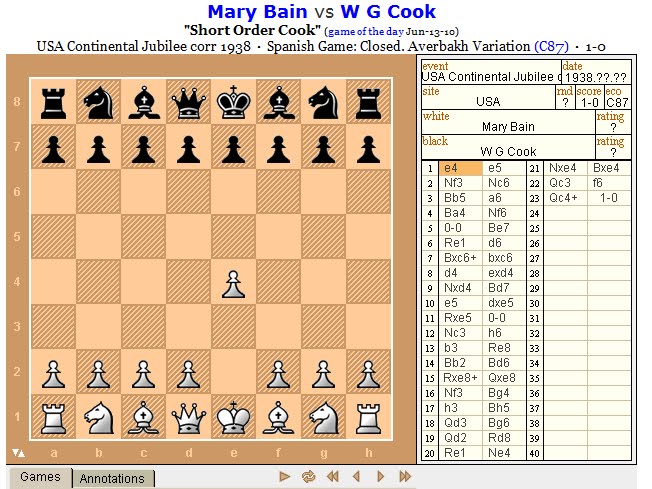
That "1. e4" now appears on the board! Hopefully, this is the move you thought was indicated by 1. e4 meant. If it wasnt, that is ok. You will get the hang of chess notation eventually.
Hit the arrow again. You will see that Black's e pawn moved forward to e5. Looking at the list of moves, you will see that in the second column besides the "1", there is the notation "e5". This is Black's first move.
You can continue hitting the arrow button, and White's moves from the first column and Black's moves from the second column will be played.
When you get to White's 5th move, you will see "0-0" in the list of moves. Remember from above that this represents King side castling. "0-0-0" represents Queen side castling. Once again, for information about castling see my post A Beginner's Guide, Part 3, Castling.
Eventually you will get to White's 7th move, "Bxc6+". Remember the "x" represents a capture, and White has just captured Black's Knight. The "+" represents a Check, and Black's King is currently under attack by White's Bishop.
Interestingly, this game does not feature any moves where more than one of the same type of piece can use a square. So there isnt any "Nbd7" or "R2e4".
Finally, notice how the "#" symbol isnt used in this game. This is because the Black player, W G Cook resigned before getting checkmated. Cook resigned in the final position because he was about to lose his Light Squared Bishop on e4, and didnt want to play on a piece down. It is common in chess games for players to resign before they get checkmated.
Going through games on a chessgames.com or a similar site that shows the board, the 1 through 8 and a through h markings on the side of the board, and the moves on the side in algebraic notation is a good way to learn chess notation. Try and find the moves that are notated before clicking the next move arrow. Then, click the next move arrow and see if you are right. After a while, reading the chess notation will become second nature.
Another benefit from learning chess notation in this way, is that by going over these high level games you will begin developing your chess intuition. You will not understand a lot of what happens on the board, but your brain will start to put together various pattern. This is a critical part of improving your chess, and you will be getting a head start!
A Beginner's Guide, Part 1, How do the pieces move?
A lot of people with an interest in chess dont ever follow through with that interest because chess is difficult, time consuming, and to a certain degree a pain! However, chess can be a very rewarding hobby. A major obstacle to beginner's getting these rewards, though, is starting out. Starting out studying chess and focusing on improving is probably the most difficult part about chess. However, with appropriate guidance, some of the worst obstacles can be overcome.
The first major obstacle in starting out playing chess is learning how the pieces move. It takes a while to get a handle on how the pieces move. Unfortunately, I will not be able to provide that much help in this area, as I learned how the pieces moved when I was very young. I dont really remember how it happened, it just happened. Also, I am somewhat doubtful anyone can provide much help. That said, Chess for Beginners is a nice looking site that could be helpful. Chess, the wikipedia article has some very nice diagrams that should get you started. [I was actually going to add some diagrams, but it would just be repeating information that is already thoroughly on the internet elsewhere.]
Really, though, there are no tricks to learning how the pieces move. You just have to make it part of your intuition, your subconscious. The best way to learn how the pieces move is simply to watch chess games and play chess games. Most Windows computers these days come with a program called Chess Titans. Playing a bunch of games on this program should help you figure out how the pieces move. Very helpfully, Chess Titans will not let you make illegal moves! This should help the beginner get a handle on how the pieces move.
If your computer does not have Chess Titans, you can get free chess programs off the internet that will do the same thing. I will discuss the various computer programs you can use in A Beginner's Guide, Part ??, Computer Chess Programs, but for now just use Arena. This is the program I will recommend, anyway, though other programs are worth looking at.
Even simpler, just visit Shredder, and you can play against the computer without even having to download anything.
As far as verbal cues as to how the pieces move, here is a very simple list that may help:
King: 1 square in any direction
Rook: Lines, up and down or side to side
Bishop: Diagonals
Queen: Can move like a Rook or a Bishop, both Lines and Diagonals
Knight: This is the trickiest piece. Moves in an L-shape and is the only piece that can jump over other pieces
Pawns: Also very tricky. Pawns can move 1 square forward, but cannot capture the 1 square forward. Pawns can capture two squares, diagonally to the right and diagonally to the left.
Pawns also have two special moves. The first is that a Pawn can move 2 squares forward on its first move. The second is something called en passant. As a beginner, dont worry about en passant until it comes up. It rarely comes up, and will just confuse you at these early stages.
So as can be seen, only the Knights and Pawns should give the beginner any trouble. The other pieces move in fairly straight forward ways. Just remember: King, 1 square in any direction; Queen, moves like a Rook and a Bishop; Rook, moves in straight lines up and down or side to side; Bishop, moves on the diaganol; Knight, tricky L Shape; Pawns, straight ahead 1 square, but captures ahead 1 square diagonally.
Reading over the above a few times should give you a fairly decent grasp on how the pieces move. You will probably forget, though. Dont worry about it. That is why you are using the computer, so it can remind you!
A last thing to mention is Castling. Just know that it exists, but dont worry about it too much at this stage. Even World Champion Candidates have difficulty with that one! [Korchnoi v. Karpov, look at the 18th move]. A beginner should not spend too much time worrying about it.
For more information about castling, read A Beginner's Guide, Part 4, Castling.
The best way to learn how the chess pieces move, and this is generally good advice, is to just ignore your own deficiencies. When you bungle some move, or you didnt see your opponent's threat, that is fine, and should be expected. You shouldnt fret about these inaccuracies. Instead just work on building up your intuitive vision. After you play and watch enough chess games, you will not make those mistakes anymore.
It is especially easy for adults to get frustrated when they screw up. This probably is the major reason children learn so much faster than adults, though I am no expert in this matter. Adults are more prone to getting frustrated and quitting, whereas children dont really even realize how hard something is and keep at it. It helps that children have tons of time.
I may be hitting you over the head too much with this, but seriously, do not get frustrated! Just play games over and over again and expect to lose. Your brain is an exceptional tool, and will do all of the learning for you, so long as you dont get in the way!
If you are a child, or if you are reading this because you want a child to learn the moves, it shouldnt be all that difficult, honestly. So long as they enjoy the game, they will probably just pick it up without even really thinking about it. I am not a parent, so I dont know much about raising children, but if the child is not interested in even learning the moves, maybe chess is not for them. Or, maybe it is just the wrong time.
If you are trying to force a child to learn the moves of chess, I would guess making it as fun as possible is the best way to go. Also, perhaps rather than forcing them to play chess, just prohibit them from doing other activities that you do not want them to do.
Saying, you can do whatever you want, but you cant watch TV or play video games, seems like it would be better than saying, we are going to sit here for an hour and you are going to learn how to play chess. The kid is probably going to want to do something, and so long as other things like TV and video games are eliminated, the kid will do something more productive.
Like I said, I am no parent, though, so I am not even sure why I am giving this advice. My advice seems to make sense, though, so more likely than not it is totally wrong! To all parents, good luck!
What a tangent. As a recap, the best way to learn how the chess pieces move is to play games of chess on the computer. The computer will not let you make illegal moves, so you will know instantly when you screw something up. Do not get frustrated if you miss a move by the computer and get checkmated or lose your queen. That is part of the learning process, and if you play enough of these games you will get the hang of it. Remember, you are playing to learn, not to win.
Tuesday, June 8, 2010
World Open 2010 Preparation Part 2
Tactics Problem Marathon.
The benefits of a tactical marathon are fairly obvious. Spotting tactics is key in chess, and can also be difficult. Tactics are basically the way you win games, so it is very important to be able to execute tactics well. Tactics also tend to be sharp, where the right move wins and a wrong move loses. So, it is especially important to play tactics accurately. You can usually get away with mistakes in the opening and endgame, but tactical mistakes can lead to completely lost positions.
Another aspect of tactics is that it helps your defense. If you are under an attack by your opponent, spotting all his tactical opportunities and parrying them can prevent a loss.
The problems of tactical problem marathons are fairly large though.
First, tactics are a very specific and small portion of a chess game. Focusing entirely on tactics gives you a very skewed study approach, and a very skewed view of the game. Sure, you can spot mate in 3s like nobody, but how does that help you the rest of the game?
Second, tactical problems have answers. A real game of chess has no answers. This brings up the classic anecdote, "Nobody is going to whisper in your ear that you have a mate in 2 during a chess game." Often, this anecdote is used as a reason why a chess tactic book author did not label his tactics. That doesnt really get to the heart of the problem, though. Nobody is going to whisper in your ear that you have a tactic. Nobody is going to even tell you you have a winning position. Really, nobody should be talking to you about your game while it is in progress anyway. That is unethical!
The point to all the above is that tactic problems set up artificial situations that simply do not occur in real games. Your brain is not practicing the right stuff. Maybe an good analogy would be an engineer being told that a bunch of materials he has make a machine. He can practice that for years, but he wont be all that well prepared when his boss comes in and says, I need you to make this machine, and doesnt give him any of the materials.
That is probably a pretty bad analogy. Oh well! It is not as bad as reading a lot of books about how to drive, instead of just driving. Tactical problems, after all, do get you a nice amount of practice in executing the tactics.
The player really has to work hard, though, to make sure he is thinking not just about solving the problems, but also about the way the various pieces of the problem are set up in the very beginning. A lot of this can be done intuitively, but a little bit of concentration can increase make the problem solving much more effective. Time, after all, is of the essence.
Another related problem with tactics is that they focus way too much on guessing out of a variety of aggressive moves. For instance, if you are given a tactical problem, you can pretty much cancel out thinking about the pawn push h6. Sure, it may be good to protect the g5 square, but this is a tactic so that cannot be the answer. There must be something better. The same thing goes with that quiet developing move, Rfe8. Probably not the answer to the tactical problem. Instead, lets try Nxe6, sacrificing the Knight for a pawn, or Bh3 sacrificing the Bishop to open up the King side, or Qh5 threatening mate in 1. Those are the types of moves that are going to be the answers in a chess tactic problem. The problem is, those arent necessarily the types of moves that are going to be answers in a real game. Rfe8 or h6 may very easily be the best move.
Finally, and this is mostly related to internet chess tactic sites, especially Chess Tactics Server, is that they focus way too much on speed and way to little on accuracy. I used to use Chess Tactics Server, but it was very annoying and probably counterproductive to try and solve all the tactics in 3 seconds or less. Truth be told, I havent used their site in a long time, so maybe they have added an untimed setting.
It doesnt really matter to me because Chess Tempo does have an untimed setting. If you do tactics under the Standard setting, the amount of time you take has no impact on the amount of rating points you get for the problem. You can take 60 minutes on one problem, get it right, and gain the same amount of rating points as someone who did it in 3 seconds. I wouldnt recommend spending 60 minutes on one problem, tournament games arent that long! But 3 to 5 minutes is a pretty good amount of time.
For those who say the ratings dont matter, it is true. The ratings dont matter at all, and I used Chess Tactics Server for quite a while just ignoring the ratings and going for 100% accuracy. However, it is difficult to judge your success or your rate of improvement when you have a rating that has little to no correlation to your success or rate of improvement. It is like Austin Powers, where he is taking Photographs of the one girl, and he is snapping his fingers annoyingly and shouting "Ignore me doing this, Ignore me doing this!" It is funny because that is not an effective way of going about doing things.
I am actually going to do a whole separate post reviewing Chess Tactic resources online, so I wont get too much more into all of this. The main point I wanted to make was, for the love of God, do not do Blitz tactics to prepare for a Tournament game. Accuracy is much more important than speed.
Well, I better get to those tactics!
Monday, June 7, 2010
World Open 2010 Preparation Part 1
My main way of preparing for the World Open right now has been to play what I call marathon Blitz game sessions. I believe this benefits the following:
1) Openings
By playing Blitz games, I can fine tune my opening play, just by trying different things out and seeing what happens. I usually find that at tournament games, this is the best way to prepare the opening, as no matter what I study, I always end up facing new moves!
2) Tactics
A big part of Blitz chess is tactical awareness. By playing at faster time controls, I am ideally training myself to spot tactics faster. I also like this way of studying tactics, as opposed to doing problems, because you develop and finish off the tactics. The problem with studying tactical problems is that you dont get any practice developing those tactical positions. It is all well and good to find the winning move when the problem sets it up for you, but this can leave you a bit deficient while trying to find the moves that lead to the winning move.
I often find that when I do an excessive amount of tactical problem studying, I play in a very boxed in manner, trying to find winning combinations instead of trying to play solid positional attacking chess.
3) Attacking chess
Because a Blitz game is over quickly anyway, it is easy to sacrifice material and just try out different attacking ideas. This can be bad or good for a player, though. For me, I usually play very dry, conservative drawish chess, so pressing forward with attacking ideas is usually a good thing for me.
4) Concentration
This is where the marathon aspect comes in. Tournament chess is a lot about concentration, and continuously calculating lines and searching for new ideas. Playing a lot of chess games over a longer period of time helps develop a more constant concentration. Plus, with the Blitz nature of the games, a lapse in concentration usually leads quickly to a loss. This is not always the case in slower games, and is especially not the case in studying games from books. I may totally miss something in a slower game, and be fine because I find it before I move. Studying from a book, I may never know I missed something. With the Blitz games, you get fairly immediate negative feedback when your concentration lapses, and this is helpful.
5) Endurance
By the 5th or 6th game, I am usually fairly tired. This is a great time to study chess! From experience, I know that I will get tired during this tournament, especially by the later rounds, and the evening games. By playing Blitz marathons, I am ideally building up a bit of endurance, so that even if I get tired, I can still function reasonably well.
Here are the downsides:
1) Sloppy
Blitz games tend to be very sloppy, and a lot of times you get away with bad moves. This is not ideal, because you wont get away with these kinds of bad moves in a tournament game.
2) Excessive attack
In Blitz, the attacker usually wins. It is difficult for players to find key defensive moves when the clock is ticking. In a tournament game though, if there is a defense, you better bet your opponent will find it. Sure, maybe my Nxf7 idea works in Blitz a lot, but that doesnt mean it will work in a tournament game.
On top of this, knowing that various attacking chess works in Blitz but not tournaments can screw up my confidence and intuition. I dont want to be in tournament games saying to myself, sure that worked great in Blitz but here in the tournament it might not work! That kind of thinking may lead to even more conservative drawish chess than if I had never played these attacking Blitz games in the first place.
3) Positional considerations, especially pawn structure
In Blitz games, it is fairly rare for pawn structure to matter that much. Usually the open file or easy piece development is fine compensation for the doubled pawns or isolated pawns. In a tournament game, though, your opponent will be able to put up a solid defense, and carefully play the endgame. Your easy development and open file may not be nearly enough compensation for the doubled pawns.
4) Bad positions
In Blitz, come from behind wins are fairly easy to achieve. I can get a cramped, terrible position out of the opening, play a few active moves, sacrifice a pawn or three and win. This can end up hurting opening play, as I will think I get away with more than I actually can.
Weighing the Pros and Cons, it seems that the best way of using this sort of preparation is to do one or three Blitz marathons a week. At the same time, make sure to do careful study of Master games, or even just play slow games as well. Variety really is key here.
As far as making these Blitz Marathons as valuable as possible, here are some ideas:
1) Set ratings goals, but ignore the ratings completely. This may seem like a paradox, but I think it is the mind frame that is necessary. It is very easy, on the one hand, to not value a win in a Blitz game very highly, and even if you try consciously to play as hard as you can, your subconscious is not going along for the ride. On the other hand, it is very easy to focus solely on getting that rating up, and trying to win over trying to play good chess. A way to handle these competing things is to set a rating goal for the end of the Marathon, and thus putting a little bit of long term goals into it. While playing the Marathon, though, avoid looking at the rating as much as possible. Just focus on the chess.
2) Play Openings you never usually play. This can actually work really well, as you get that overall opening experience, without picking up bad habits in the openings you normally play.
3) Focus your games on a few ideas.
This is a little difficult to do in chess, as your opponent's moves are going to heavily dictate what you should do, but it may be a good idea to set little themes for yourself for a couple of games. For instance, you can play a bunch of games where you try and go for as early an attack as possible, and see how things go with that. Then play a bunch of games where you really focus on completing your development as harmoniously as possible and come up with solid positional mid game plans. Then, play some games where you are just trying to get a good endgame. Coming up with these different themes can help you get a handle on the different sort of ideas associated with these types of play. This will also give you a nice handle on what works and what doesnt.
4) Play when you are tired
This is probably the hardest thing to do, but it may very well be the best. When your mind is slipping, it is very easy to not want to play any more games. But at the same time, really trying to consciously get yourself back on gear can be a very helpful thing to be able to do.
Well, I am going to try and go for another one of these Blitz Marathons right now.
Subscribe to:
Posts (Atom)

